Article
Making hybrid working measurable
2 March 2026
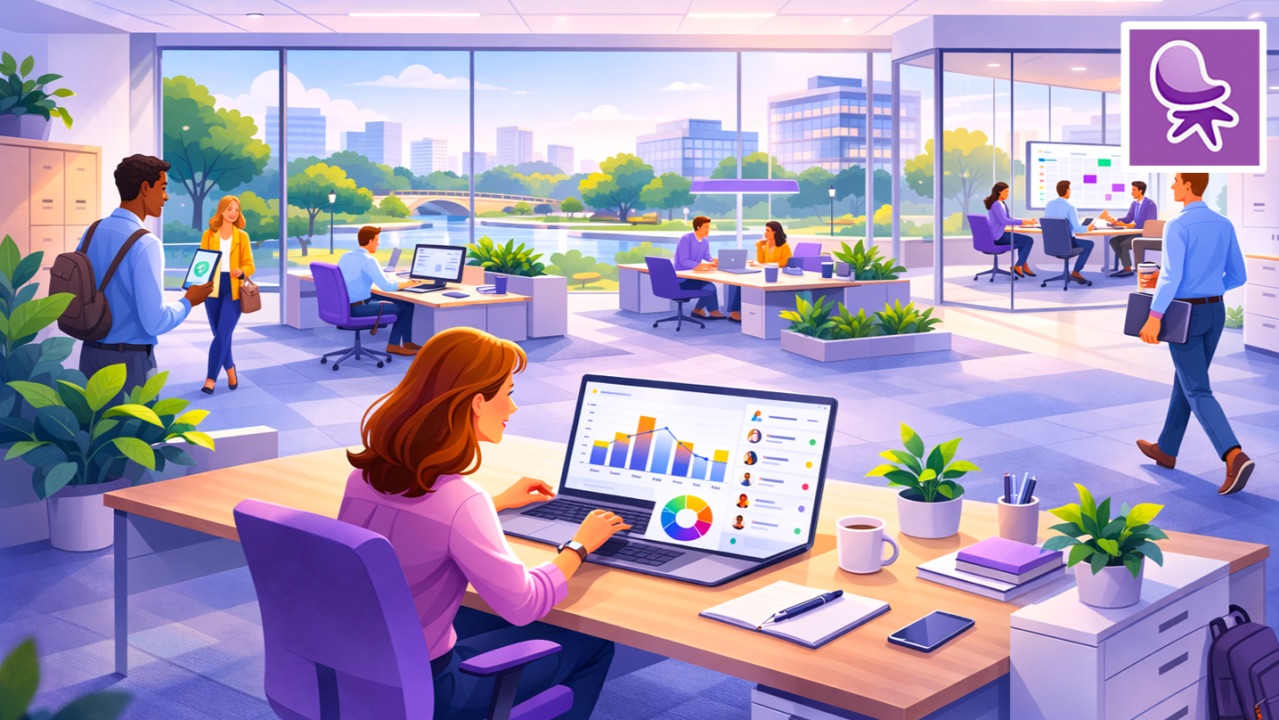
From gut feeling to well-founded space decisions.
The first two articles were about direction and organisation, what you want to achieve with hybrid working and how you make sure attendance is not a matter of chance. The third step is often underestimated, while that is exactly where maturity lies.
Once the agreements are in place and teams organise their attendance, something valuable emerges, and that is insight. Not based on opinions, but on behaviour over a longer period. That insight decides whether you keep hesitating or make choices with confidence.
Why policy is not enough
Many organisations do sense that their office is no longer in proportion to its use. There are days with visible empty space and days when it feels cramped. That chafes, but as soon as the conversation turns to square metres, everyone suddenly becomes cautious.
- What if it gets too busy after all?
- What if collaboration comes under pressure?
- And what if we run short of space later on?
Without consistent insight every decision stays nerve-racking, and so nothing changes.
What measuring really delivers
A single busy day says little. What does matter is the pattern over months, because then you see what is structural and what is a one-off. How peaks develop, which teams often meet each other and which zones consistently stay empty.
Where the conversation used to be about "it feels too busy", afterwards it sounds more like this.
We see that occupancy on Tuesdays is 74 percent on average, with a few predictable peaks.
Optimise before you change your floor space
Insight does not mean cutting square metres straight away, by the way. The first gain usually lies in smarter organisation, such as aligning team days better, setting up zones more clearly and responding to the peaks you can now see coming.
Only after that comes the question whether you can change your space permanently. Space decisions then become the result of insight, not the starting point.
An example from practice
At
DEKRA they wanted to understand better how much office space was really needed. Not to save money straight away, but to plan for the future. By making attendance and occupancy visible over a longer period, it became clear where space was consistently empty and where the peaks were. The conversation about space became rational instead of gut-driven.
At HelloFresh insight had an impact too. The organisation grew but did not need to rent extra office space, because continuous visibility of occupancy and spread meant the growth was absorbed within the existing square metres.
In both cases measuring made the difference. Not saving for the sake of saving, but matching space to how people actually work.
Thinking ahead
If you measure consistently, you can think ahead. How often do we really reach our maximum capacity? Which space is needed permanently and which only occasionally? You explore scenarios without intervening straight away, and that is exactly what builds support.
When you know the moment has come
The moment to review space is not when it looks financially attractive, but when the data shows it can be done for the long term.
- Peaks are predictable.
- Empty space is a pattern.
- Teams know when they will meet each other.
- Attendance feels organised.
The essence
Hybrid working matures when three steps reinforce each other.
1. You decide what you want to achieve.
2. You organise attendance deliberately.
3. You measure what happens and adjust based on behaviour.
Measuring is not control, it is the foundation for sustainable space decisions.
Wendel, AppjePlekje
Read more

Customer story
Scildon
Read customer story

